The Time of Red: A Mediation on Artemisia Gentileschi’s ‘Judith Beheading Holofernes’
London, 2025
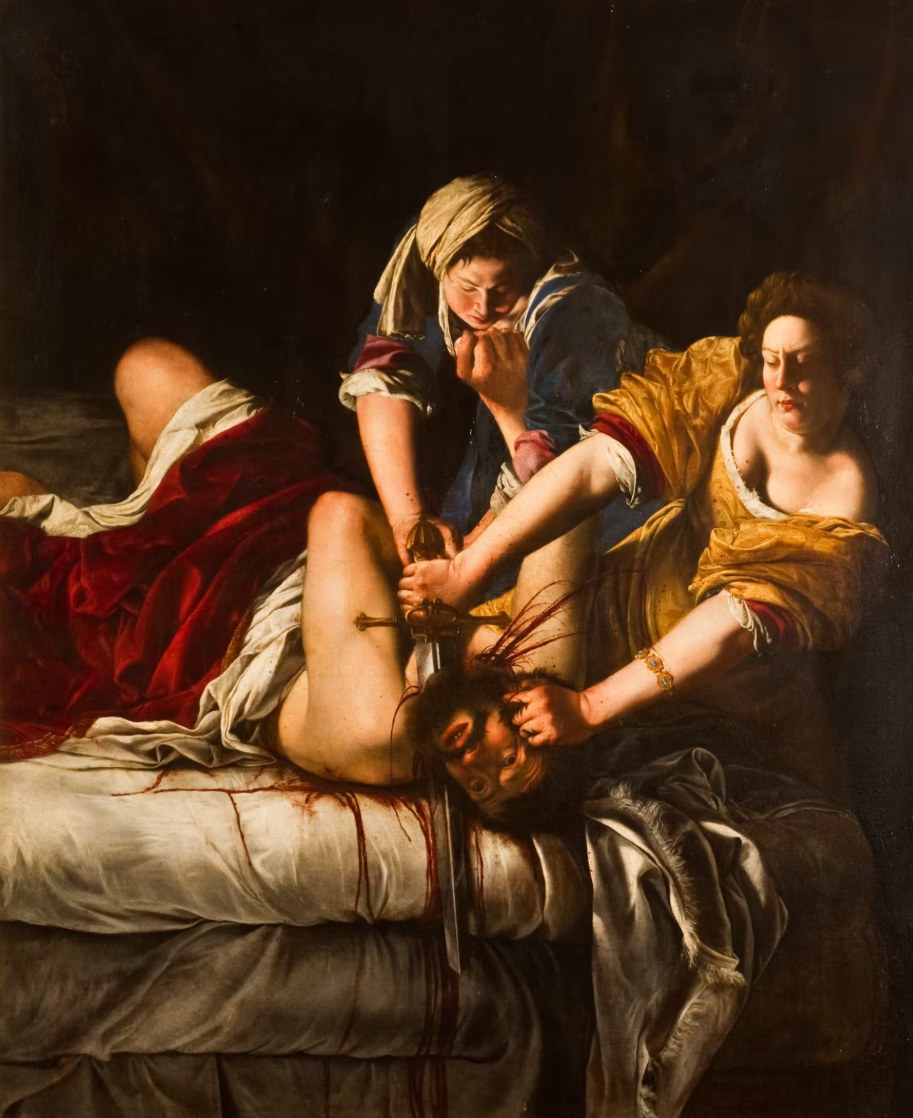
Artemisia Gentileschi, Judith Beheading Holofernes, 1620, oil on canvas
I. Encounter
It begins with the red.
Not the blade, not Judith’s determined grasp, not even the violence of the act - but the red that leaps outward before the eye has time to gather itself. A red that behaves like motion, like force, like a gesture flung toward the viewer across an impossible distance. It does not sit placidly within the oil; it arcs, it insists.
The first time I stood before Artemisia Gentileschi’s Judith Beheading Holofernes, I felt the painting before I saw it. The arterial red broke open the distance between canvas and body. It reached toward me, unmediated by narrative. That is the power of this red: it establishes contact before comprehension. It touches before it represents. It makes itself known as an event.
Phenomenologists tell us that colour is relational - a lived encounter, not merely a pigment vibrating at a certain frequency. And here, Artemisia stages that encounter with uncompromising force. The red is not symbolic. It is experiential. It bypasses cognition, arriving directly in the nervous system.
Only after the shock does the scene assemble: Judith’s focused posture, Abra’s braced body, Holofernes’ futile resistance. But even then, everything radiates from the red. It anchors the composition, exerts gravitational pull, orchestrates the gaze. Judith’s action folds around it, but the red remains the central agent, the cardinal gesture.
Artemisia begins with sensation.
She begins with the body.
She begins with the moment where painting and viewer collide.
This is not the polite encounter expected of historical art. It is something more dangerous - a breach of temporal boundaries, a colour that refuses to remain in its century. The viewer is pulled into a present tense shared with the painting, a “now” that feels almost too intimate.
The painting begins by undoing us. That is its first mercy and its first affront.
II. Engagement
Once the red has seized the viewer, the painting reveals its architecture: a stage already in motion. Artemisia gives us no establishing shot. No introduction to setting or character. The curtain is open; we have wandered into the climax.
Theatricality saturates the scene.
The bed tilts toward us like a raised platform.
The drapery behind Judith hangs with the gravity of stage velvet.
The concentrated illumination functions as a spotlight, isolating the figures in a cone of heightened presence.
This is not simple realism. It is dramaturgy.
Artemisia is directing our gaze, shaping our temporal experience. The painting unfolds as performance. Judith and Abra lean outward, not inward; their bodies angle toward the edge of the canvas, toward the viewer’s space, pulling us into the trajectory of action. Holofernes’ contortion, that muscular spiral of resistance, becomes a force line drawing us even deeper.
The perspective is too close, too intimate, too claustrophobic for safe spectatorship. We feel ourselves standing at the foot of the bed, within the perimeter of violence. Here, looking becomes participation. The viewer is not situated outside the event; we are implicated by proximity.
This is where the “death of the author” becomes necessary. If Artemisia remains within arm’s reach of interpretation - if we tie the scene too tightly to her biography - the painting collapses into explanation. It becomes commentary rather than encounter.
Artemisia recedes, deliberately.
Her life is not the script.
Her trauma is not the interpretive key.
Her withdrawal makes the painting possible. She leaves the stage so that Judith may enter fully, so that colour may speak in its own tense, so that viewers may feel the full force of the act without the buffer of biography.
The painting’s temporality is that of a held breath, a suspended gesture. It is the space between decision and consequence, between action and aftermath. Artemisia extends this space until it becomes almost untenable. The viewer inhabits that pressure.
Judith performs.
The red performs.
And the viewer is drawn into the performance, willingly or not.
The engagement is no longer with Artemisia.
It is with the moment itself - luminous, violent, electrified with attention.
III. Entanglement
And then the red changes.
It deepens, broadens, thickens into something atmospheric. Behind Judith’s arm, the drapery smoulders with a dense, contemplative red. This is not the red of eruption but of absorption - a chromatic gravity that steadies the composition, making space for reflection after the shock.
Two reds, two temporalities.
One violent, one contemplative.
One that strikes, one that holds.
Between them, a field of richness opens.
The viewer enters this field almost unconsciously, drawn in by the dialogue between chromatic intensities.
This is the phenomenological heart of the painting: meaning is not contained in narrative, nor in symbol, but in the lived, embodied experience of colour as relation. Sobchack reminds us that images do not merely appear to us; they address us, act upon us, sense us. And here, the red recognises the viewer. It pulls us into its field, sensing our gaze, responding to it with shifts of temperature and density.
We are entangled in this reciprocity.
We do not simply look at the red; the red also looks at us.
This is where colour behaves queerly - not in identity, but in its refusal of categorical containment. The red is too much: too beautiful, too horrific, too ceremonial, too bodily. It queers the scene by resisting reductive moral clarity. Judith becomes both executioner and heroine. Holofernes becomes both monstrous and painfully human. Violence becomes both necessary and uncomfortably intimate.
The painting does not settle these contradictions.
It lets them coexist, unresolved.
It insists that we remain within them.
That is its queer force.
And from that force emerges something hopeful.
Perhaps this is where the queer behaviour of colour reveals its deepest meaning: in its resistance. Red refuses singularity. Red refuses obedience. Red refuses the comfort of fixed interpretation. That refusal is not chaos; it is promise - a gesture toward futures not yet formed.
Queerness is not only disruption here; it is opening.
It is possibility.
It is the shimmering edge where meaning has not yet hardened.
In Artemisia’s painting, this queerness of red tells us that even within violence, even within the darkest suspense of the moment, something can shift, something can become otherwise. Resistance becomes a form of hope - a belief that meanings can change, identities can transform, histories can be undone and remade.
To feel this hope is to feel the painting’s deepest temporal pulse.
Not the time of Judith.
Not the time of Artemisia.
But the time of colour itself - unfolding in us, in the present.
This entanglement frees the painting from biography.
The work exceeds the life that produced it.
It becomes an autonomous event, relived and renewed each time a viewer steps into the interval of its reds.
IV. Release
And yet Artemisia is difficult to release.
Her biography is unusually vivid for a woman of her time.
We know the courtroom.
We know the torment.
We know the humiliations she survived.
We know because the archive lets us know.
But knowing is not the same as understanding.
And understanding is not the same as possessing.
For decades, critics have tethered her paintings to her trauma as though fastening a rope. They have made her art carry the weight of her biography, flattening its multiplicity into a single narrative of revenge, catharsis, or testimony. It is a gendered reflex - the habit of reading women’s art as confession while allowing men’s art abstraction and autonomy.
But Artemisia’s work is too expansive for that.
It resists such use.
It exceeds the life that surrounds it.
To see her painting clearly, we must separate the art from the artist - not to deny the woman, but to honour the painting.
The act of separation is not disrespect; it is grace.
It is the recognition that we cannot know Artemisia’s thoughts.
Not truly, not intimately, not with the precision biography tempts us to claim. We have documents, not consciousness. Events, not interiority. To insist otherwise would be to repeat the very violence of interrogation she once endured - the demand that a woman reveal her inner life for the satisfaction of others.
Let us give her the dignity of unknowability.
Let us give her the grace of privacy.
Let us give her the freedom she was not afforded in her lifetime:
to speak through her work without being spoken for.
When we release Artemisia from the frame, the painting steps forward.
It becomes what it has always been - a living event of colour and encounter.
A site where red performs its own truths: its resistance, its queerness, its capacity to act upon the present.
Artemisia’s painting surpasses history not because it escapes the past, but because it continually reconstitutes the present.
It belongs not only to 1620, but to every moment in which a viewer feels that first shock of red. To every body that enters its field of intensity. To every future in which looking remains an act of ethical attention.
Perhaps paintings are less objects than temporal propositions - not records of what was, but visions for what seeing could become.
Judith Beheading Holofernes is not an image.
It is an event.
It is an aperture.
It is a site where colour thinks, where sensation acts, where meaning trembles between formation and dissolution.
This is Artemisia’s most radical gift.
Not her biography.
Not her suffering.
Not her resilience.
But her capacity to make a work that asks us to release certainty, release possession, release the need to solve - and instead enter the time of red with openness. With vulnerability. With hope.
Red that touches.
Red that recognises.
Red that resists.
Red that outlives biography.
To stand before Judith Beheading Holofernes is to stand inside this unfolding future - a future in which art is allowed to outrun the life that produced it, and viewers are allowed to meet a painting not as historians, but as beings capable of being transformed.
This is the time of red.
A time that belongs to the painting,
and to anyone willing to truly see.
