On Red, Mould, and the Collapse of Time
London, February 2026
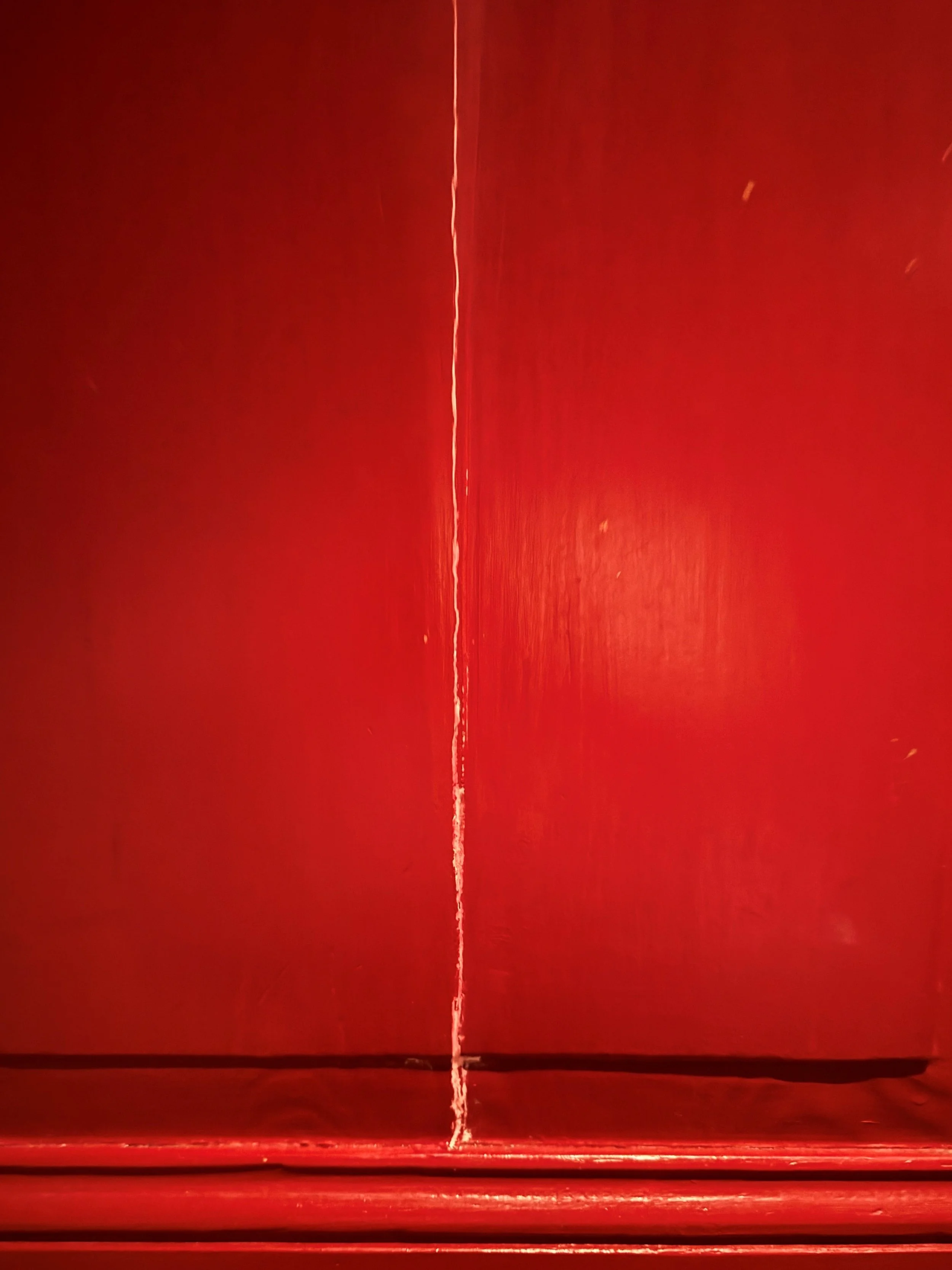
The other day, in a restaurant toilet in Victoria, London, time lost its sequence.
It did not shatter dramatically. It loosened - softly, imperceptibly - like steam lifting paint.
I closed the cubicle door and turned, and there it was: red. A red so immediate it felt less like colour and more like atmosphere. Not the solemn, matte depth of canvas, but a municipal gloss - slightly scuffed, faintly luminous under fluorescent light. It shimmered in patches where hands had brushed it over years. It rose from the thick moulding at my knees to the ceiling above, where black mould feathered outward in quiet, organic constellations.
It is important to say: I was looking at the back of a bathroom door.
Above me, the ceiling was creeping with decay. The air held the layered scent of disinfectant and damp plaster. The lock was cold and faintly greasy beneath my hand. Nothing in the room was aspiring to transcendence. And yet, standing there, I felt something pull - something old and sedimented - rising to meet the gloss before me.
Down the centre of the door ran a vertical line.
At first glance, it looked like a crack - a wound in the wood, the building quietly splitting in sympathy with my overactive imagination. But the line did not wander. It did not gape. It ran too straight, too consistently from top to bottom. Not rupture, but seam. Two panels meeting. A joining disguised as division.
And then, without permission, another red entered the room.
Onement I did not appear as an image so much as a pressure. A density. Barnett Newman’s red - darker than memory allows, earthen at its edges, absorbing light rather than reflecting it - began to layer itself over the gloss surface before me. His zip - thick with pigment, trembling slightly, thickening and thinning where the brush hesitated - hovered over the door’s pale seam.
Two reds coexisted. Two verticals aligned.
And time - obedient until then - folded.
I was in Victoria, in a cubicle with mould stippling the ceiling. I was also standing before Newman’s canvas, years earlier, at a sanctioned museum distance. I was in seminar rooms, rehearsing language around the rhetoric of the sublime. I was in memory, in study, in the present tense of plumbing and fluorescent hum. The moments did not follow one another. They pressed against each other. The door pushed forward. The painting pulled backward. My body became the hinge.
The red did not recede. It advanced.
Without the seam, the door would have been nothing more than saturated surface. With it, the field became relational. My eyes measured left against right. My spine aligned unconsciously with that vertical interruption. I became acutely aware of myself as a vertical being before a vertical articulation. Breath rising and falling in parallel.
Was it the red that built the affect so quickly?
Red is never innocent. It carries blood, prohibition, lipstick, exit signs. But this red did something more primitive. It enclosed. It sealed the small cubicle into a chamber of colour. The pragmatic moulding at the bottom of the door - a horizontal insistence on architecture - tried to anchor the scene, to restore scale. Above, the black mould quietly bloomed, undoing any grand reading. The sublime, if it dared to appear, was hemmed in by decay.
There is something undeniably comic in this. To be staging a private drama of modernist transcendence beneath a ceiling stippled with damp. To feel the rhetoric of postwar abstraction stir while inches from a lock that has known countless anonymous hands. The indecency of it. The disproportion. I sound like a prick.
And yet the seriousness persisted.
Because Newman’s zip is not a slash. It is not violence. It is a joining. A measure. In Onement I, the line does not divide the field so much as call it into coherence. It situates the viewer. It makes you aware of standing there - now.
The door’s seam, though born of carpentry rather than conviction, did the same. It was not a crack. Not collapse. A meeting. It marked the possibility of opening. It divided and unified at once.
Time did not flow forward in that moment. It thickened. Years of holding that painting in peripheral thought condensed into gloss enamel. Scholarship dissolved into sensation. The museum dissolved into plumbing. The red in front of me and the red in memory were not separate events but simultaneous presences, layered like paint.
Someone coughed outside. Water ran in the pipes. The mould continued its quiet expansion across the ceiling.
The door did not split. The world did not open.
But for a suspended interval - elastic, nonlinear, almost embarrassingly intense - the space flattened into a field, and I felt myself drawn, divided, and gently rejoined along a trembling vertical line.
When I unlocked the door, chronology resumed its ordinary duties. The restaurant returned. The red stayed where it was. The mould continued to bloom.
And yet something had shifted. A seam had revealed itself - not in the wood, but in perception - where past and present, high modernism and municipal decay, transcendence and toilet, pressed briefly into one.
A joining, disguised as a crack.
A sublime, improbably hinged.
And possibly the only time in my life I’ve felt existentially rearranged by a bathroom door - which either means the moment was real, or I’m a bit of a twat.
“The problem of a painting is physical and metaphysical, the same as I think life is physical and metaphysical.”
