The Scar Does Not Resolve the Wound
London, sometime around Easter.
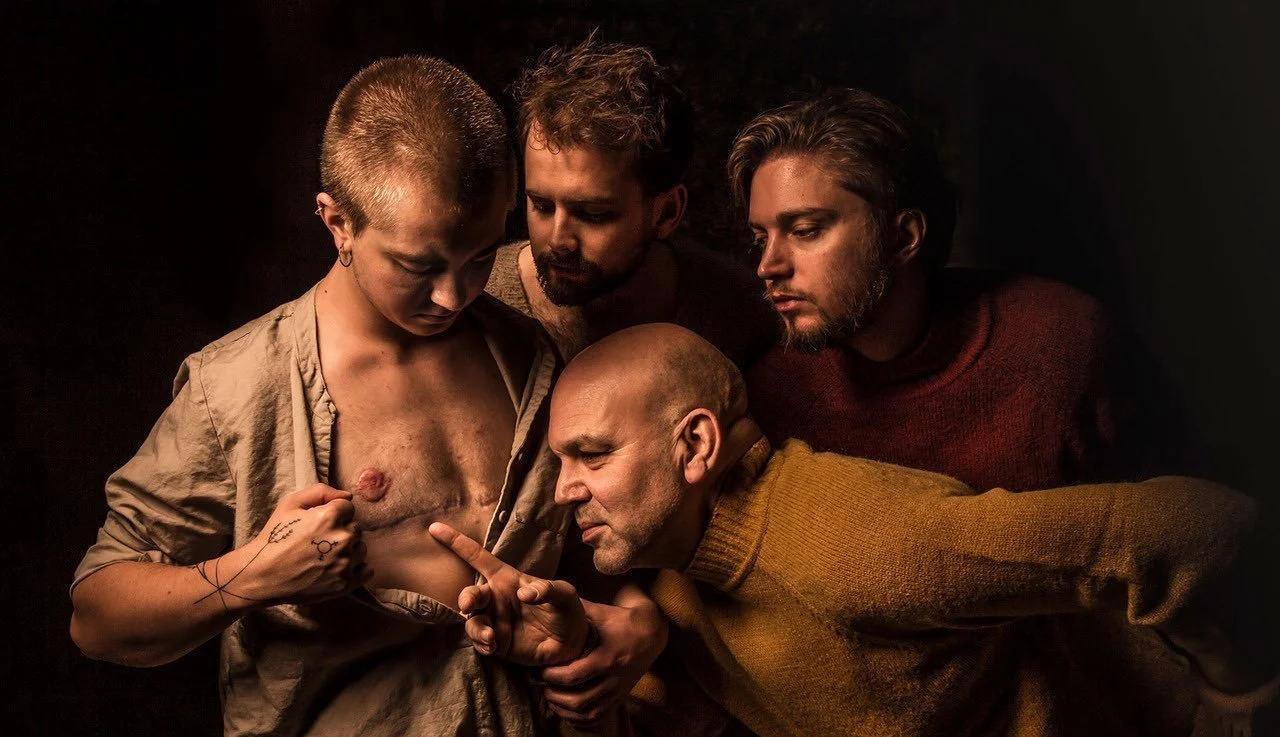
Elisabeth Ohlson Wallin, ID:TRANS, 2017, digital photograph
The scar does not resolve the wound. It suspends it within time.
In Elisabeth Ohlson Wallin’s reworking of The Incredulity of Saint Thomas (c. 1601-1602) (ID:TRANS, 2017), the wound that structures Caravaggio’s composition does not disappear; it is displaced, redistributed, and made durational. Where Caravaggio stages the wound as a site of epistemological crisis - an opening through which belief might be secured - Ohlson Wallin returns that opening to the surface of the body as scar. The cut is no longer momentary. It has already happened. It persists.
Caravaggio’s wound is an event. It is organised around a temporality of immediacy: the instant of doubt, the instant of contact, the instant in which the body is opened to confirm what cannot otherwise be known. Thomas presses his finger into Christ’s side as if truth could be extracted from flesh, as if the body might yield certainty under pressure. Yet the painting refuses this resolution. The wound, though exposed, remains bloodless. It withholds as much as it reveals. Vision and touch converge, but knowledge remains unstable, contingent, incomplete. The body is made available, but not fully legible. Belief is staged as something that cannot be secured, only enacted (Bersani and Dutoit, 1998).
Ohlson Wallin does not resolve this instability; she thickens it.
The wound returns as scar, and with it, a different temporal logic. The scar does not belong to the instant of incision but to what Henri Bergson would describe as durée: a continuous, qualitative unfolding in which past and present are not separable but coextensive (Bergson, 1910). The scar carries the memory of the cut without reopening it. It is not a site of entry but of persistence, a surface that holds within it the layered accumulation of pain, healing, and transformation. If the wound in Caravaggio promises access - to truth, to divinity - Ohlson Wallin’s scars refuse access in this sense. They do not open inward. They extend outward, across time.
This extension reconfigures the relation between body and knowledge. In Caravaggio, the body is interrogated: touched, probed, verified. In Ohlson Wallin, the body resists interrogation. The scars are not there to be tested; they insist on recognition. This distinction is not minor. It marks a shift from an epistemology grounded in verification to one grounded in recognition, in which the body is no longer the object through which truth is extracted, but the site through which presence is asserted. Recognition here is not a passive act of seeing, but an ethical demand. It asks what forms of legibility have historically determined which bodies can be known, and under what conditions - and what violences are enacted when they are not (Butler, 2004).
The scar, in this sense, is not simply a mark. It disrupts the conditions through which bodies are made legible.
It refuses to stabilise into a singular meaning. Like Christ’s stigmata, it binds together suffering and transformation, but without resolving that tension into redemption. It remains excessive to interpretation, resisting the closure that symbolic frameworks might impose. This resistance aligns with queer theoretical accounts of temporality that reject linear progression in favour of delay, repetition, and recursion (Freeman, 2010). The scar does not mark a movement from injury to healing as a completed sequence. It holds both within itself simultaneously. It is neither past nor present, but an ongoing negotiation between the two.
José Esteban Muñoz’s formulation of queerness as a horizon - something not yet here, but felt as a potential within the present - offers a way of understanding this temporal instability (Muñoz, 2009). The scar, like queerness in Muñoz’s account, is not reducible to what has already happened. It gestures toward what continues, what remains open, what has yet to be fully realised. It is a mark of having been, but also of becoming. It refuses to settle into the past. It insists on the present as a site of ongoing transformation - one shaped through transition, not merely marked by it.
Colour intensifies this temporal complexity. Ohlson Wallin’s use of red, set against a subdued palette that recalls the tonal warmth of early modern painting, operates not as a stable signifier but as an affective force. In Caravaggio’s painting, the absence of blood within the wound produces a tension between visibility and withholding. The wound is opened, but its interior is strangely evacuated of colour. Red is implied, but not present. This absence is not neutral. It structures the painting’s affective economy, producing a sense of suspension in which the promise of revelation is deferred (Fried, 2010).
Ohlson Wallin does not simply restore what is missing. She displaces it.
Red reappears, but not within an open wound. It adheres to the scars, tracing their surfaces, marking the body not at the moment of rupture but in its aftermath. In doing so, red ceases to function as the immediate sign of violence or sacrifice. It becomes durational, attaching itself to the ongoing life of the body. It circulates across time, linking Christ’s suffering with the lived realities of trans and queer embodiment. This chromatic redistribution transforms red into what might be understood, following Freccero, as a hauntological trace: a persistence of past affect within the present, refusing to be contained within a single historical moment (Freccero, 2005).
The scar thus becomes a site of haunting.
It carries within it the spectral presence of the wound, not as something resolved or overcome, but as something that continues to shape the body’s surface. This is not a return of the past as repetition, but as pressure - a force that insists on its ongoing relevance. In this sense, the scar aligns with queer hauntology’s insistence that the past is never fully past, that it remains active within the present as a destabilising presence. The body becomes a site through which this temporal entanglement is made visible.
This entanglement extends to the act of looking itself. Caravaggio’s painting already stages a crisis of perception, in which sight and touch fail to produce stable knowledge. Ohlson Wallin intensifies this crisis by shifting its focus from belief to recognition. The viewer is no longer positioned as one who must decide whether to believe what is seen, but as one who must confront the limits - and violences - of their own perceptual frameworks. What does it mean to see a body shaped through transition? What histories of exclusion and erasure structure that seeing? The scar does not provide an answer. It holds the viewer in a state of suspension, in which perception is revealed as contingent, historically produced, and never neutral (Crary, 1990).
Photography amplifies this effect. As a medium associated with the real, it collapses the distance that might otherwise allow the viewer to maintain a position of interpretive detachment (Barthes 1981). The scars are not easily relegated to the symbolic or the historical; they insist on their presence in the present. Yet this immediacy is complicated by the photograph’s painterly qualities - its muted palette, its softened edges - which fold it back into the history of painting. The image occupies both registers simultaneously, resisting any clear distinction between past and present, representation and reality.
Within this unstable field, the scar operates as a point of convergence. It brings together wound and healing, past and present, visibility and opacity. It does not resolve these tensions, but sustains them. It refuses the logic of closure that would separate injury from survival, or transformation from its conditions of possibility. Instead, it insists on their co-presence.
The scar does not heal the wound. It carries it forward.
It makes visible a temporality in which nothing is fully left behind, in which the body remains marked by what it has lived through and actively become, and in which those marks cannot be reduced to singular meaning. In Ohlson Wallin’s work, the scar is not simply a trace of what has happened. It is a condition of what continues. It is through the scar that time becomes visible, not as sequence, but as accumulation, as persistence, as something that cannot be fully resolved.
To look at the scar, then, is not to decode it, nor to master its meaning, but to remain with it. It is to encounter a body that refuses to stabilise, that resists the demand for legibility, and that insists on its own ongoing transformation. It is to recognise that what is carried on the surface of the skin is not evidence of lack, but of survival, self-determination, and becoming. The scar does not offer access to truth. It demands a different relation to it - one grounded not in verification, but in the recognition of lives that persist, insist, and continue to unfold.
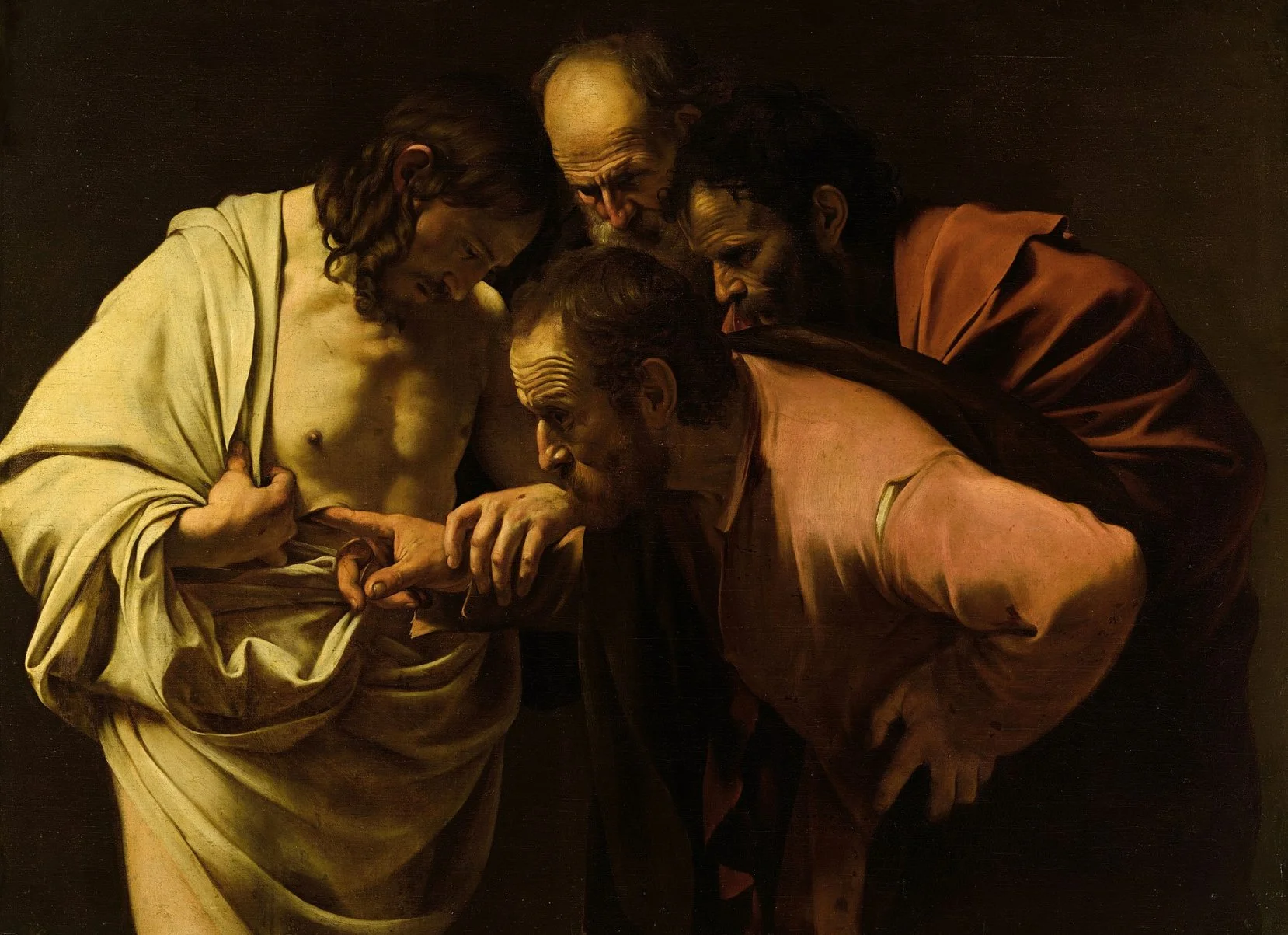
Caravaggio, The Incredulity of Saint Thomas, c. 1601 - 1602, oil on canvas
