The Persistence of Unfinished Selves
Glasgow, April 2026
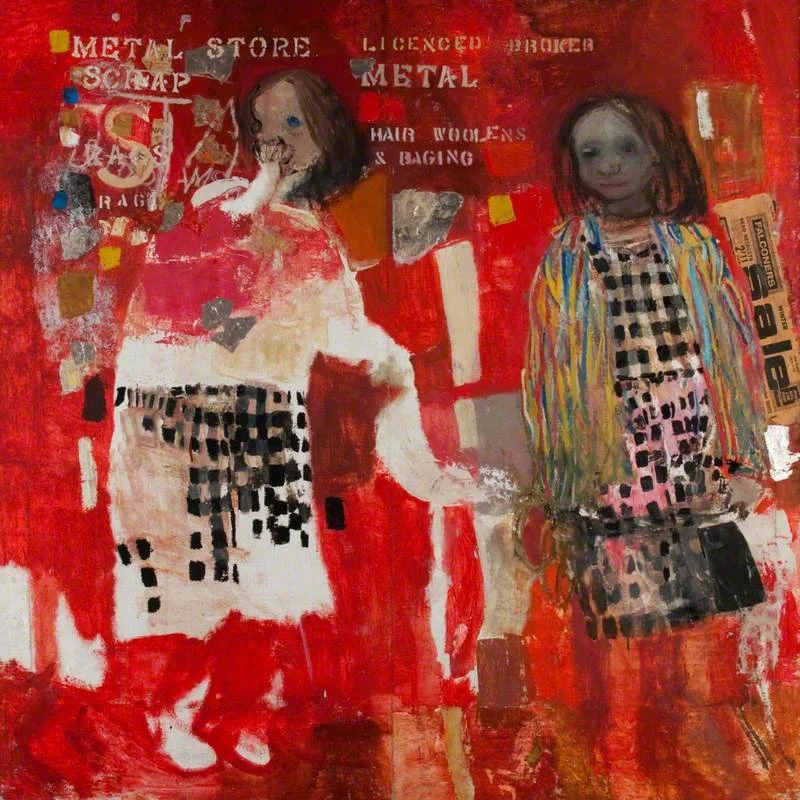
© the Eardley estate. All rights reserved, 2026 DACS. Image credit: Glasgow Life Museums
There are some places that do not hold memories so much as they hold versions of yourself. Returning to Kelvingrove recently, I realised that the museum has never existed for me as a neutral container of art or history. Its corridors, staircases, and vast echoing galleries feel inhabited by every self I have ever been there. The walls have seen me in childhood, in adolescence, in fear and in pride. They have watched me move through confusion, ambition, shame, desire. To walk through the museum now is not simply to revisit the past, but to feel the unsettling coexistence of temporalities - the strange sensation that earlier versions of myself are still moving somewhere alongside me.
The experience is difficult to explain because it exceeds memory in its conventional sense. The museum does not inspire memory so much as bodily recognition. The feeling is not nostalgic, or at least not nostalgia in its sentimental form. It is a rippling awareness that I am retracing my own steps through those echoing halls, becoming briefly doubled with earlier versions of myself. Even the building seems to participate in that doubling: the soft drag of shoes against stone floors, the sudden expansion of space as galleries open out unexpectedly, the particular quality of Glasgow light filtered through high windows and settling unevenly across varnished frames. Kelvingrove feels less like a static institution than a space saturated by temporal residue. The museum does not simply preserve the past; it allows the past to leak continually into the present.
This is what hauntology attempts to describe: not the gothic return of ghosts, but the persistence of unfinished time. Derrida’s hauntology emerges from the recognition that the past never fully disappears, that certain histories remain unresolved and therefore continue to structure the present as absences, echoes, afterimages. Haunting is not an interruption of time’s order but evidence that time was never orderly to begin with. Certain spaces become thick with these temporal collisions. Kelvingrove operates like that for me. It is not a container for memory but a site where memory continues to happen.
And always, somewhere within that choreography of return, there is Joan Eardley’s Two Children (1963).
I cannot remember first encountering the painting because I feel as though I have always known it. The work exists in my memory less as a discrete object than as an atmospheric condition of the museum itself: red, towering, watchful. It lingered somewhere in the background of every visit with such consistency that it became inseparable from Kelvingrove’s architecture - as though the painting itself had entered the building’s emotional climate. Returning to Glasgow recently, returning to Kelvingrove, I realised that the painting does not merely remind me of childhood. It produces the sensation of childhood as something still partially alive, still moving somewhere alongside me.
Entering the gallery now produces less the excitement of seeing a familiar artwork than the uncanny sensation of finding something that has been quietly waiting for me. The scale of the painting still catches me off guard. As a child, it felt enormous - not simply physically large, but emotionally vast, capable of swallowing me into its scarlet atmosphere. Even now, the red of the background seems to vibrate outward into the gallery space itself, as though it refuses containment by the frame. The painting does not sit still in my memory; it recurs. It arrives repeatedly, across decades, altered slightly each time by the person I have become while somehow remaining exactly itself.
Other people often recoil from the painting. They call it eerie. Disturbing. The children, they say, look haunted.
I have never understood that reaction.
Not because the work is not haunting - it absolutely is - but because its haunting has never felt threatening to me. The children do not appear monstrous or spectral so much as temporally displaced. Their expressions refuse resolution. The taller child raises a hand ambiguously toward her mouth, caught somewhere between eating, silencing herself, or reacting to something just outside the frame. The smaller child gazes outward with a subdued exhaustion that feels impossibly adult. Around them, fragments of Glasgow street life accumulate across the surface of the canvas: scraps of newspaper, metallic sweet wrappers, stencilled signage advertising “metal store scrap” and “hair woolens & baging.” The city does not sit behind the children as backdrop but presses itself into them materially, threatening to absorb them entirely into the scarlet field.
The painting feels constructed from remnants. Eardley layers the canvas with the flotsam and jetsam of post-war Glasgow: scraps, fragments, broken language, urban residue. The stencilled words drift above the children’s heads like detached signals from another moment in time. Everything in the work feels partially worn away, partially surviving. Hauntology is always concerned with precisely these forms of persistence - the survival of traces, the endurance of atmospheres, the strange way material objects retain emotional and temporal charge long after their originating moment has passed.
And perhaps this is why the work feels so profoundly alive to me. It does not depict memory; it behaves like memory. Fragmentary. Repetitive. Unfinished.
Standing before it now, I realise how deeply the painting shaped my understanding of time long before I possessed the theoretical language for it. Queer theory becomes important here precisely because queerness has so often involved alternative experiences of temporality: delayed arrivals, recursive identities, forms of becoming that resist neat chronology. Sara Ahmed’s work on orientation helps explain why I experience the work differently from many others. What feels disconcerting to them feels familiar to me. I do not require the children to resolve into stable emotional subjects because queerness itself often involves learning to inhabit ambiguity and incompletion.
José Esteban Muñoz’s understanding of queerness as something ephemeral and always on the horizon feels startlingly present within Eardley’s unfinished children. They seem caught in suspension, neither fully arriving nor disappearing. But more than this, they seem to exist outside linear time altogether. Each time I return to Kelvingrove, they remain there waiting - unchanged while I have changed around them. Yet the encounter itself is never identical. The painting gathers my different selves into the same room.
The fact that Two Children was found unfinished on Eardley’s easel after her death only intensifies this sensation. The work itself remains permanently unresolved. Its rough surfaces, fragmented collage, and unstable forms resist closure both formally and emotionally. It is difficult not to feel that the painting continues reaching toward something it never entirely arrives at. In this sense, it embodies hauntology materially: a work suspended between presence and absence, completion and abandonment, persistence and loss.
Returning to Kelvingrove, then, becomes more than an act of nostalgia. Nostalgia imagines the past as closed and recoverable. Hauntology understands the past as unfinished - still active, still capable of shaping the present. The museum transforms into a site where temporal boundaries loosen. The child who once stood staring up at Eardley’s scarlet canvas still exists somewhere within the act of looking. So does the adolescent moving uncertainly through those halls. So does the adult returning now, carrying the accumulated knowledge of all those earlier selves.
None of us have entirely left.
And perhaps that is what haunting really is. Not the return of the dead, but the persistence of unfinished selves, unfinished histories, unfinished feelings - all refusing, quietly and continuously, to disappear.
